
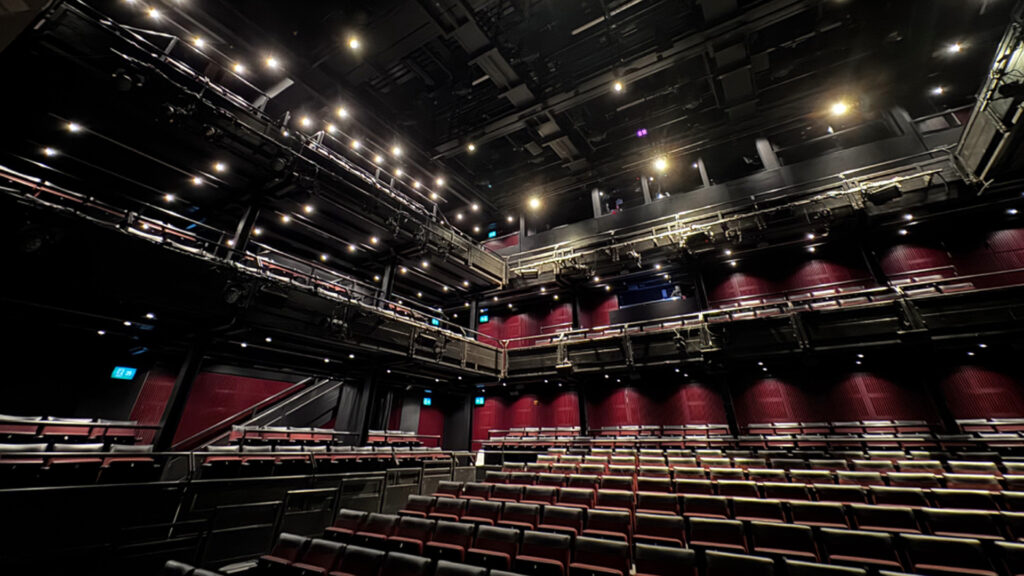
Located on London’s Southbank, the National Theatre (NT) is one of the world’s most iconic theatrical venues. Opened 50 years ago in 1976, it stages over 20 productions every year, with these taking place across its three auditoriums: the Olivier – the largest venue, with its fan-shaped auditorium; the Lyttelton with its conventional proscenium arch; and the compact and flexible Dorfman.
In 2024 it was announced that the NT was to benefit from significant investment from the government as part of the institution’s Stories Start Here project. Along with enabling the creation of a new NT Skills Centre – offering resources, training and professional development for those interested in careers in theatre – the funding was to be used to repair and replace aging technical systems across the site.
As part of this, work in the South Bank site’s smallest space, the Dorfman, included: the provision of a new lighting control infrastructure, featuring an extensive, fully reprogrammed ETC Paradigm system; new sound and video infrastructure; new automation power infrastructure, including a brand-new Tait flying system; new fire alarm and security systems; and new ventilation and cooling upgrades.
Additionally, as part of a separate project, the venue has also installed a new assisted listening system, with all upgrades ultimately delivering an elevated experience for the Dorfman’s many visitors, both on and off stage.
FULL HOUSE
To overhaul the venue’s house lighting system, specialist auditorium lighting consultant 3LR Lighting was approached to provide a lighting design that covered the Dorfman’s auditorium, emergency and work lighting, and to acquire a range of new ETC fixtures for the space.
“As with any upgrade undertaken within the National, we wanted to ensure the Dorfman was not only equipped with the latest technology, but had a lighting design that allowed the space to achieve its full potential,” opens Paul Hornsby, NT’s lighting infrastructure manager. “Having previously worked with 3LR’s Matt Lloyd on architectural lighting upgrades across the NT over the years, we knew he would be ideal to guide us through this process and offer expert advice.”
3LR’s Matt Lloyd explains: “The brief given to us was to formulate a new lighting design for the Dorfman which would allow perfectly dimmable lighting across all areas of the auditorium, as well as the ability for audience members to read their programme easily in every seat.
“We needed to ensure the design encompassed every variation of the auditorium, from end-on stage, to thrust stage and even in-the-round. There was also an emphasis for us to draw on ETC products – which the theatre had already invested in and for whom we are a manufacturer representative.
“Alongside creating a design, we also had to ensure we covered all aspects and light levels for emergency lighting in the auditorium and scene dock areas.”
Following initial conversations with the venue, 3LR’s in-house lighting designer Karoliina Helin devised a scheme for the space. She explains: “Whereas previously there were large dark gaps present throughout the auditorium, I wanted to create a design that allowed complete coverage and for each row of seating to be given the same treatment.
“We needed to improve the staircase lighting to allow safe access (even at very low levels) whilst the performance is taking place. Similarly, as an ETC manufacturer’s rep, we could actually develop the design using the brand-new Navis 50 FTW fitting with F-Drive RX as the centralised drive unit back in the dimmer room. This was absolutely crucial as it allowed us to work out how to get the correct fitting into the auditorium, given most of the areas have extremely limited ceiling height to install the necessary infrastructure.”
EVEN COVERAGE
Design work took place over four months, before seven months of stripping the venue of its old system and replacing it with the new infrastructure.
3LR’s initial design work was brought to life by integrator Push The Button (PTB), led by managing director Nick Ewins and design manager, Andy Phillips. As with 3LR, the team from PTB was familiar with the NT having also previously installed new house lighting systems in the larger Olivier and Lyttelton theatres.
In the Dorfman, PTB carried out the detailed design stage and installed all of the new luminaires and drivers before handing over to the NT’s Lighting Control team, headed by Andrew Grant (lighting control manager).
ETC’s ArcSystem Navis 50 FTW (fade to warm) architectural luminaires were specified and procured fresh off the production line, as Lloyd explains: “Whilst we knew they were the perfect fixture for the auditorium, we also knew this meant acquiring all 387 of them a good 12 months before they were being publicly launched. Thankfully, given our relationship with ETC, we were able to do just that. The impact they’ve made within the space is incredible.” These are powered by the newly-launched ETC F-Drive RX centralised LED power control system, situated in the Dorfman’s dimmer room.
“What has made this project such a success is our close collaboration with our principal contractor Push The Button, to help finalise the design work and then deliver the whole project without compromising the quality that we are used to on all our other installations,” says Hornsby.
He adds: “The auditorium looks amazing. There is even coverage over each level of the theatre, along with beautiful sculpting along the walls and staircases, with the aisle lights having plenty of light for safety access. Similarly, the provision of emergency lighting gives us really high and even light levels, which is a vast improvement and something we are proud of.
“Simply put, Karoliina and the team at 3LR have given us a lighting design solution which is super flexible for whichever show and auditorium design is thought of. Also, by drawing on the ETC F-Drive and Navis products, we have taken a bold approach in the future-proofing of the theatre for whatever comes next.”
He concludes: “Standing in the auditorium now, it looks the same as it did, however, no area was left untouched with every single cable and technical system replaced – because, if you get such a fortunate window as a full closure, it’s best to get to everything in one go!”
HEAR SAY
As well as the upgraded house lighting, the Dorfman has also benefitted from the installation of a new Williams AV Auracast-enabled hearing system. This marks the third type of assistive listening technology running concurrently across the NT’s three venues, representing the institution’s commitment to inclusive theatre-making.
“I’m accountable for the relationship the National Theatre has with anyone who’s deaf, disabled, or neurodivergent, whether that’s our audiences, staff, or freelancers at the South Bank, on tour, in cinemas, or in our bookshops and cafes,” begins David Bellwood, NT’s head of access.
His role centres on identifying where barriers exist and either removing them or making meaningful adjustments. “Historically, society followed a ‘medical model’ of disability, focusing on an impairment and what’s ‘wrong’ with the individual,” Bellwood describes. “We focus on the ‘social model’, looking at factors in society and theatre-making that inadvertently disable people.
We want to move from seeing access as a concession into seeing it as a living, breathing part of our creative processes and facilities.”
Ben Steinitz, NT’s building systems and compliance manager, is responsible for communication systems, paging, non-theatre audio systems, TV, digital signage, assistive listening and radio frequency management across the building. “I started here 21 years ago as the sound department’s bench technician and quite quickly got involved in the accessible hearing systems we had at the time across all three theatres,” he recalls. “At that time there was nothing suitable available as a replacement option, so I ended up taking on the job of keeping it going – it was already quite old at the time!”
In considering the NT’s current provision, Steinitz and the team have been resolute in ensuring the widest possible compatibility while pursuing the latest technological improvements. In practice, that means maintaining multiple systems concurrently.
The two larger theatres – the Lyttelton and the Olivier – now have induction loops installed in the floors. “Anyone with a hearing aid with a telecoil in the Lyttelton or the Olivier doesn’t have to ask for technology,” Steinitz explains. “They can walk straight in, and, if their hearing aid allows, switch to the telecoil, and they will get the audio feed.”
The team noted, however, that the telecoil function is increasingly being omitted from modern devices. It was also not feasible to install an induction loop in the smaller Dorfman theatre. “We weren’t able to put an induction loop into the floor because of the structure,” he explains. “The floor has a lot of metal, and the main stalls area is on many different small lifts.”
In 2022, the NT installed a Williams AV Infrared system across its three theatres, replacing a previous-generation solution.
The appeal of the system was multifaceted.
The familiarity of the headset design – with tactile features that allowed partially sighted users to navigate the volume knob and power switch by feel alone – was a significant factor. Improved battery technology, enhanced audio quality, and crucially the ability to run the system over Cat5 cable, allowing flexibility and integration with existing infrastructure, added to the appeal of the system.
But the line-of-sight requirement inherent to infrared emitters created some challenges, particularly in the Dorfman.
“Infrared is challenging in there because of the requirement for line of sight,” Steinitz explains. “It’s a studio theatre with a lot hanging from the ceiling and a high upper circle. You’ve instantly got to avoid a shadow from equipment or scenery, and because you’re firing from such a low angle, if someone tall is sitting in front of you, it’s even more of a problem.”
AURACAST
The answer came in the form of the Auracast standard. Developed by the Bluetooth Special Interest Group (SIG), in collaboration with hearing aid manufacturers, Auracast is a capability within the Bluetooth LE (Low Energy) standard that enables one-to-many audio distribution – delivering the same audio stream simultaneously to an unlimited number of compatible devices. Classic Bluetooth connections operate at ranges of up to 10m; Auracast extends that to 100m. Alongside hearing aids, compatibility is now being increasingly built into consumer headphones, earbuds and receivers.
“Auracast looks to us to be the future – a new platform, equivalent to telecoil in terms of universal compatibility,” states Steinitz. “And for us, the new Williams AV Infinium system offered an elegant deployment of that technology and was the obvious choice given our previous positive experience with the company.”
Julian Young of Williams AV adds: “With the Infinium, we wanted to remove every barrier between the listener and the performance. Auracast gives us the platform to do that at scale and venues like the National Theatre show exactly what’s possible when the technology is deployed with real ambition.”
The Infinium system was sourced from Williams AV’s UK distributor Audiologic, via specialist integrator Nuway AV.
The Dorfman is covered via a single Infinium transmitter. “We just plugged it in, configured the network, and it worked,” says Steinitz. “We feed audio directly from our FOH console via Dante to the transmitter.”
The latency achieved is less than 30 milliseconds – less than the natural acoustic delay to the furthest seats of the larger theatres. “That was an instant win for the project,” Steinitz confirms.
MOVED TO TEARS
Phil Creighton, a self-confessed Auracast advocate who writes about the technology on his blog AuraHear.com, has a deeply personal interest. “My hearing loss runs in the family; it’s something I’ve grown up with,” he explains. “Over the years I’ve had to own it and come to terms with the fact that I have a severe to profound hearing loss. If I take my hearing aids out, a truck could come up behind me with its horns blaring and I’d be completely oblivious. I rely on technology to help me interact with the world.”
His first meaningful encounter with Auracast was at St Paul’s Cathedral, listening to a tour guide. “The novelty of being in a big, noisy space and being able to hear moved me to tears,” he recalls. “I still have emotional experiences at new venues because I’m so used to the worst sound experience possible.”
What distinguishes Auracast from previous assistive technologies, in Creighton’s view, is its discretion and its universality. “The beauty of the Auracast standard is that it makes assistive listening discreet, which I really appreciate and value. It’s also accessible for everyone – and it’s not just for people with hearing difficulties, but for anyone who wants a boost, an audio description track, or a translation.”
Steinitz emphasises access system considerations are now embedded in the production design of every NT show, with the sound team routinely creating a dedicated dialogue mix for all accessibility hearing feeds. “These days, most of our performances have radio microphones, which allows us to do a lot more creatively in the theatre without drowning out the dialogue, and we can also send that nice clear signal to the access system,” he says.
LOOKING AHEAD
The NT’s ambitions for the system extend beyond the Dorfman to the Lyttelton and Olivier theatres. Extending the coverage into the foyers is also a priority. “It’s very important to us that our customers know they’ve got a decent connection before they settle into the theatre space. We already have an audio track playing only to our assistive listening systems before the performance, so customers can confirm it is working for them before curtain up “ Before that expansion, the team is focused on ensuring the customer-facing experience is seamless. “We need to make sure the front-of-house teams know enough about the system to be able to talk to customers about it,” Steinitz says.
Alongside 20 of the Williams AV Infinium receivers on-hand at the Dorfman, the NT is trialling third-party Auracast-compatible consumer headphones, and the longer-term expectation is that audiences will increasingly arrive with their own compatible devices.
That vision is already beginning to materialise. “We’re already getting reports of people asking whether we’ve got Auracast, so awareness in the customer base is growing.”
THE BIGGER PICTURE
“We like to sit at the front of the wave when it comes to promoting these new options,” Steinitz reflects. “If people see the National Theatre doing something, we know they might look at it twice. What’s been really heartwarming is when customers tell us what good quality audio we’ve been able to deliver.”
With the technology already expanding into many settings, including airports and attractions – awareness of the technology amongst consumers is the next challenge. “Auracast technology lifts my spirits in a way other technology never has,” says Phil Creighton. “There are 18 million people in the UK with some form of hearing loss – one in three people – that’s why I am batting for it and telling people about it.”
For Bellwood, the significance of the NT’s upgrade cannot be understated. “If everyone can enter the auditorium and receive an equitable experience, that’s vital,” he says. “It provides agency so an individual doesn’t have to go to an usher or carry extra equipment that might be incompatible with their personal setup. They can sit with their family with no noticeable difference.”
With its new, accessible assistive listening system, re-designed house lighting system and multiple other improvements to its technical infrastructure, the Dorfman is ready for the future. The story starts here.