
Rob Halliday reports on the recent all-LED house lighting renovation at London’s Royal Festival Hall
It must be tough, knowing that you’ve put in a lot of hard work, as well as a fair amount of money, to achieve an end result that, to the audience, feels like absolutely nothing has changed. But, sometimes that’s the job – in which case, if no-one notices the change, it’s the sign of a job well done.
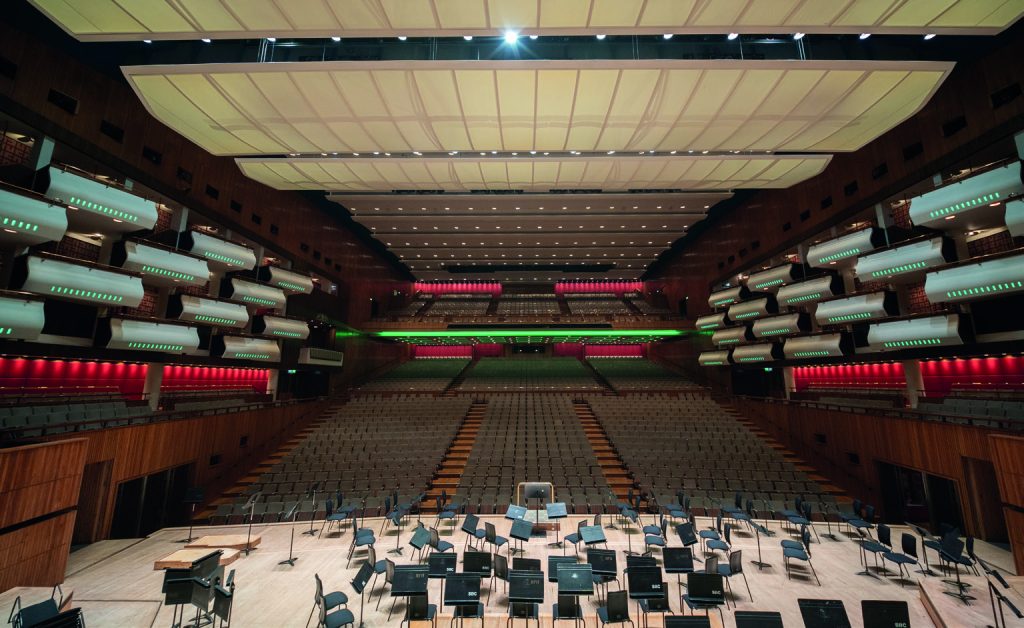
That’s certainly the case at London’s Royal Festival Hall, where the entire house lighting system has just been upgraded – more truthfully, completely replaced – to an all-LED system, but one which in its default show condition leaves the hall looking pretty much the same as before; its pale wood finishes – a hard ask for any LED light source – still glowing beautifully.
The hall opened in 1951 as a beacon of a bright, modern, hopeful future to contrast with the destruction of the War years, and is now Grade I listed. But of course, regardless of listing status, buildings like this can’t just sit still. In the case of the house lights, maintaining the existing system – predominantly tungsten, with a little coldcathode cove lighting – was becoming increasingly problematic. “It was every day, changing lamps,” recalls Roger Hennigan, technical manager for the Royal Festival Hall and the Southbank Centre of which it is a part. “Put a contemporary, bass-heavy gig in here, and it’d be 14, 15, 16 lamps the next day.
And that was if you could actually get the lamps; some of the fittings used a Radium capsule lamp with an outer glass sheath, which were out of production, so we were buying copies – and I can’t even say cheap copies, because they weren’t. Some areas, particularly some of the cold cathode coffer lighting, was just no longer working. We knew we had to do something.”
That system had a clear lineage back to the original 1951 installation, with downlighters, wall washes, plus cove lighting both in the balcony and within the curved ceiling, designed to create a wave of light out from the stage as the house lights came up. It had been refurbished as part of a buildingwide refurbishment in 2007, but now it was time for a bigger change.
PRESERVING HERITAGE
To help pull off this upgrade without any noticeable, visible change, Hennigan assembled an expert team: Jonathan Porter Goff, previously of Stage Electrics where he oversaw similar upgrades at other buildings within the Southbank complex, now working as an independent consultant; Matt Lloyd of 3LR Lighting; and Andy Booth, leading the installation team for White Light.
There were three main challenges to overcome: the light fittings themselves, the cabling and infrastructure, and then, as always, time in a venue that rarely closes to get everything in and working around shows. The process started with Goff’s initial measurements, then swapping in samples of possible new fixtures and measuring again.
“We couldn’t really do more modelling in advance, because the fixtures we were using were often combined with custom reflectors or diffusers, and there wasn’t enough data to accurately model them,” he explains. “So we’d try, then measure again, and say yes, this is better, brighter, more even . . . but now, does the fitting look right, as the heritage people required?” When they found solutions, “we left an example in the roof, and I challenged people in the department – people who’d been there for years – to spot the difference,” explains Hennigan. “When they struggled to find it, we knew we’d found the right solutions.”
The new system is almost entirely based around products from ETC’s ArcSystem and ArcLamp ranges, but often with custom reflectors or diffusers added to achieve the required look. For the ceiling downlighters, for example, the existing capsule lamps have been replaced by ETC Pro One-Cells, mounted to custom spun reflectors with custom diffusers on the front to give the correct appearance behind the existing spill rings. The larger downlighters, under the balcony and the hall’s distinctive side boxes, use ArcLamps and a larger, polished gold reflector.
ETC’s F-Drive R12 rack-mount and W1 wall-mount drivers are used to run the system.
“We are using 2,700 Kelvin fade-to-warm lamps, but they still felt a bit cold. So we experimented with a number of reflectors; we finally settled on a gold version, which made a huge difference. Suddenly it just worked, the reflector doing the work of getting us to the right colour,” Hennigan recalls. “So in effect we took out the old reflectors, and put a new one in with two ArcLamps in it, working to minimise the height so it would fit into the existing space.” These custom reflectors were made for the project by a company called Eulum, brought on board by 3LR’s Matt Lloyd.
He explains: “We had a long period of working with them, playing around with different reflector colours, finishes, different combinations of light sources, but the end result was brilliant – with the heritage people happy and no-one really able to spot what we’ve done!”
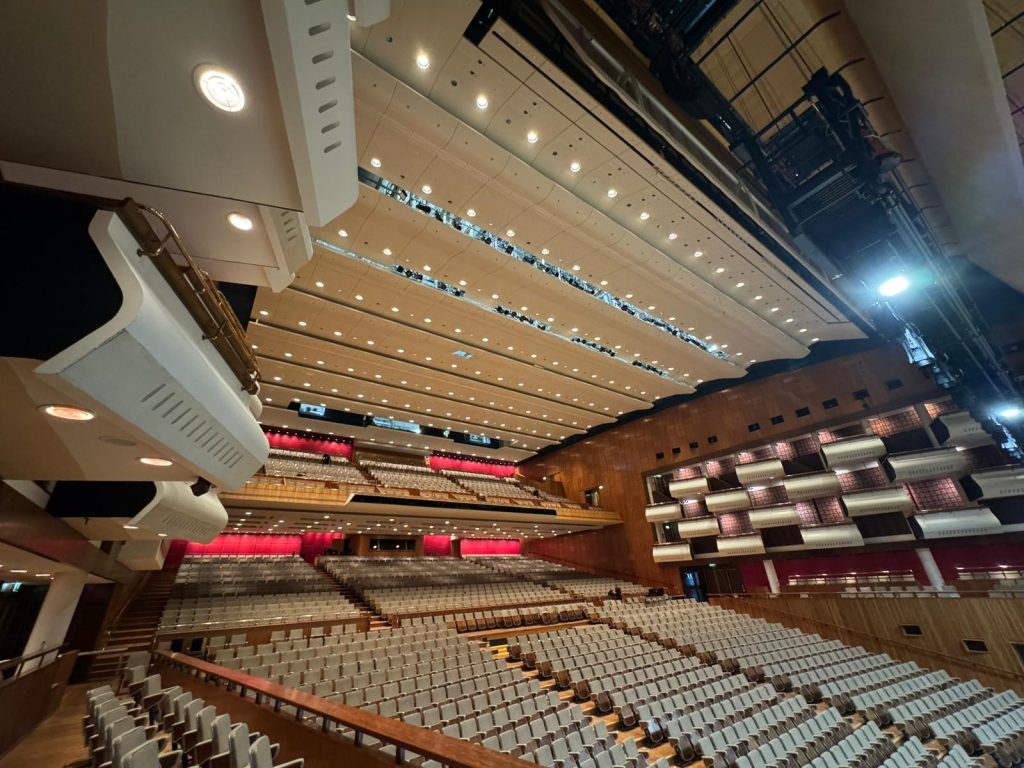
ArcLamps also provided a solution around the sides of the hall, behind the boxes, lit by a series of original 1950s fittings, refurbished in 2007.
Here the original lamps have been replaced by pairs of ArcLamps, while around the rear of the auditorium Navis 100 units have been installed as wall washes. This has replaced a system installed as part of the 2007 refurbishment, with the smaller Navis 50 units then installed in the light lobbies.
The team then worked to replace the cold cathode systems, which had long been out of action, here turning to LED tape as the solution, with colour-changing pixel tape installed under the balcony and in decorative slots inset in the box fronts. “So now if you’ve got a spare 34 universes, you can play with every pixel on the box fronts!” Hennigan notes. One part of this did get deferred: “Originally there was also cold cathode in the ceiling, hidden in the coving so you just see the reflection in the ceiling,” Goff explains. “To achieve that we experimented with three strips, two uplighting and one downlighting,” Hennigan adds.
“That meant it was going to be quite expensive, so ultimately we’ve saved that for another day.” What is back is the ability to light the two columns at the rear of the stage, in colour, using Navis 100 Chroma fixtures mounted as downlighters around the top of each column.
“The original fixtures there fell out of use because they were such a pain to reach to change the lamps; it’s been great to have those back.”
INTO THE VOID
Of course, finding the right products is one thing, installing them in a building of this era is quite another. “Overhead, the main ceiling has walkways, so that was relatively easy,” explains Booth, “with LED drivers distributed across the roof space. But under the balcony was much harder – there is a void at the back where we installed the driver farm, but the existing circuits were very oddly paired together and didn’t really bear any resemblance to the record drawings from 2007.
And strangely, one of the trickiest things was the exit signs; we’ve changed all of these to be dimmable, but the feeds for them were coming from all over the place, so rationalising that became a big project – in the end it was probably five weeks to change 26 exit signs!” The W1E emergency version of ETC’s W1 driver is used here.
Goff notes the importance of collaboration and trust: “We wrote a tender document, which White Light won, but ultimately you are relying on individuals.
Andy spent a weekend running backwards and forwards from ladder to void, identifying how everything worked; if he hadn’t done that, we’d have missed the installation window, so a lot of it came down to the commitment of him and his team.”
From the other side, Booth notes: “One of the reasons it worked so well was because it was a team effort, and the client was supportive of the work that was needed within their limited installation timeframe.” The first phase of the project took place during a maintenance period in the summer of 2024 with a team of 12, the second during the summer of 2025 with a team that peaked at 20. This also included a month of overnight work, installing a new 250 Amp mains supply for the new systems, and fitting the first of ETC’s new Foundry racks replacing obsolete Matrix racks, for power control. The team have also tried to look after future versions of themselves, making sure to leave accurate drawings for whoever has to upgrade these systems next, though with a 10-year warranty and a much longer life expected on the ETC products, that hopefully won’t be for a while.
The cost to make a change that no-one should notice? “We were under budget by £77,” Hennigan notes with a grin. “It is higher than the finger-in-the-air number I came up with six or seven years ago, but that didn’t include everything we’ve now achieved. It is quite a lot of money, but working in a building like this is never cheap. Our approach to management wasn’t to say, this will pay back through energy savings – though we have reduced the energy consumption of the house lights by 79% – it was to say, it’s not really an option to keep it as tungsten. We had to do this.”
But as Goff adds, there was also some extra motivation and an unofficial deadline: “As far as I was concerned, it had to be finished now because this is the hall’s 75th anniversary year, and I think we’ve successfully made it look more beautiful for that milestone.”
Beautiful, more flexible, and yet in many ways, remaining the same . . . by all those measures, a job well done.
If you’d like to discuss how lighting can transform your residential space, then please contact our friendly team on [email protected]